 LLM OS
 Version 0.4.4 · October 2026 · changelog
An operating system with no apps until you ask for one.
You describe a program. LLM OS writes it, checks it, sandboxes it and runs it — and rewrites it when you want something changed or it crashes.
What's new in 0.4.
Latest: 0.4.4 — Every image is now tested for what it is for. Full changelog →
- 0.4.0
A desktop you describe.
/desktopwith a taskbar or a dock, a Prompt button instead of a Start menu, Alt+Tab — and apps that can be drawn without a browser. - 0.4.1
Your data on its own disk; your changes win.
Upgrading is a disk swap. An app you changed stays yours when a release ships a newer one, and any app can be upgraded with a bigger model.
- 0.4.2
It tells you what’s running.
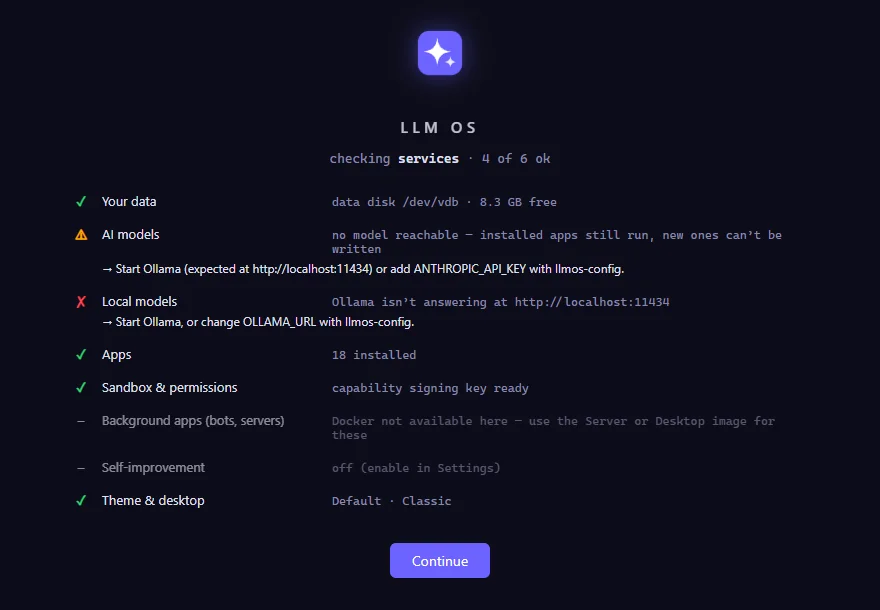
A boot screen with every service and what to do when one is missing — and a security review of the whole sandbox boundary, every finding fixed.
- 0.4.3
Make it bigger by clicking or by saying so.
The first setting that works both ways, and data that knows its format so upgrades can change it safely.
- 0.4.4
Every image is tested before it ships.
Booted and used like a person would — which is how we found, and fixed, a Desktop image that never showed LLM OS on its screen.
What it looks like right now.
Real screenshots of the prototype, not mockups.
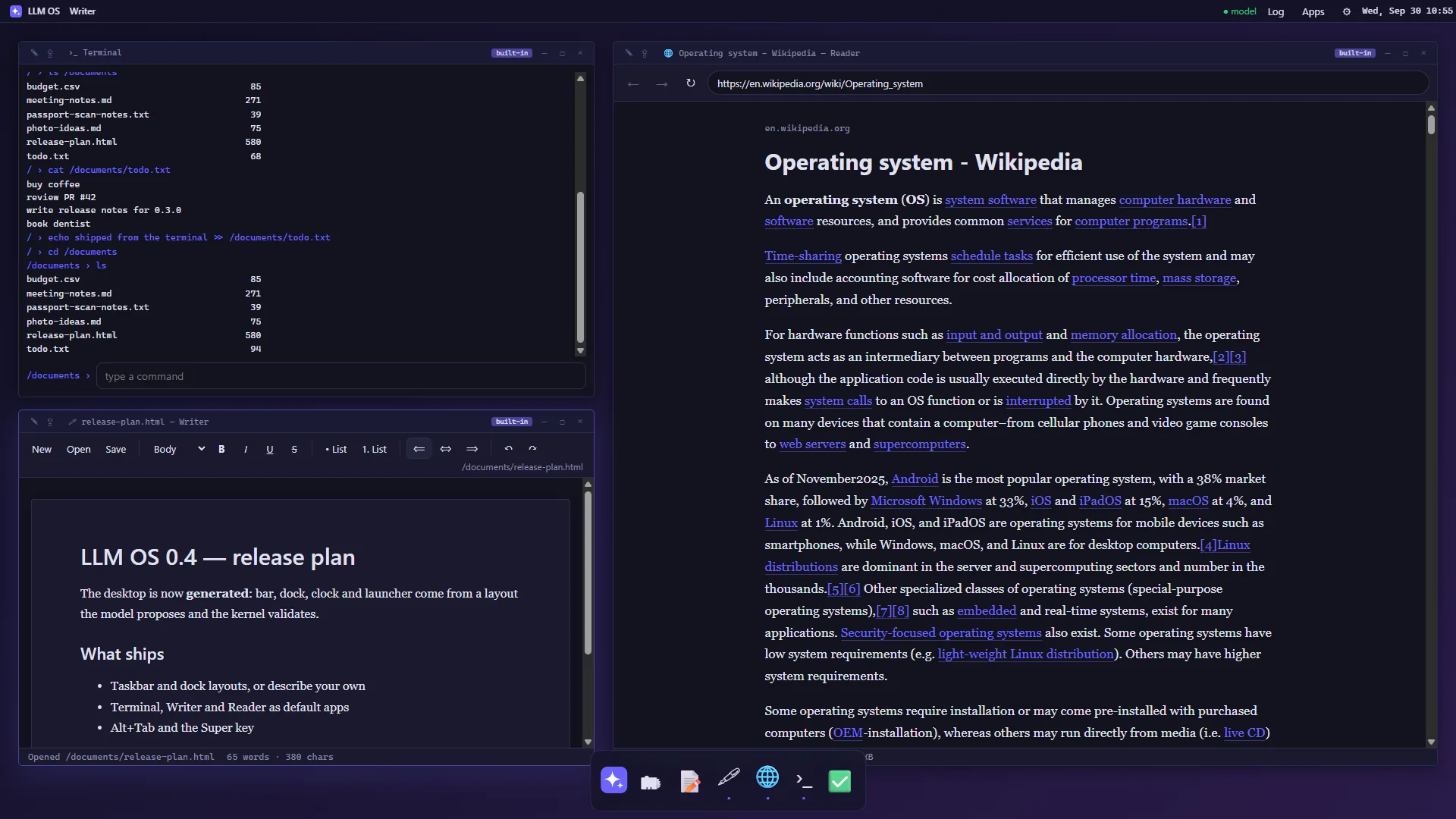
/desktop dock at 1920×1080: menu bar with the Prompt launcher, a dock with running-app dots, Terminal, Writer and Reader working on the same files.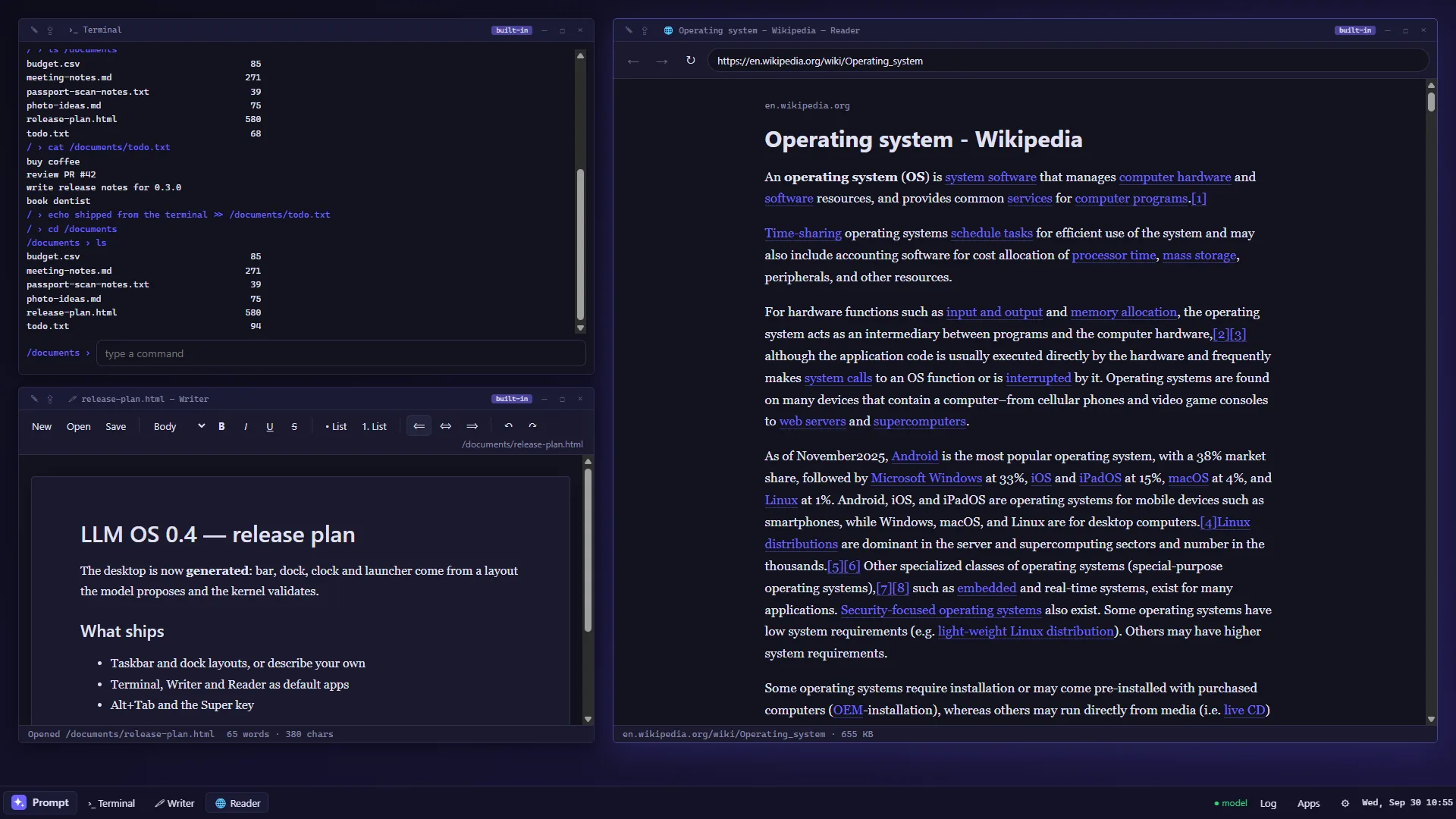
/desktop taskbar: a taskbar with the Prompt button, open windows, status and clock.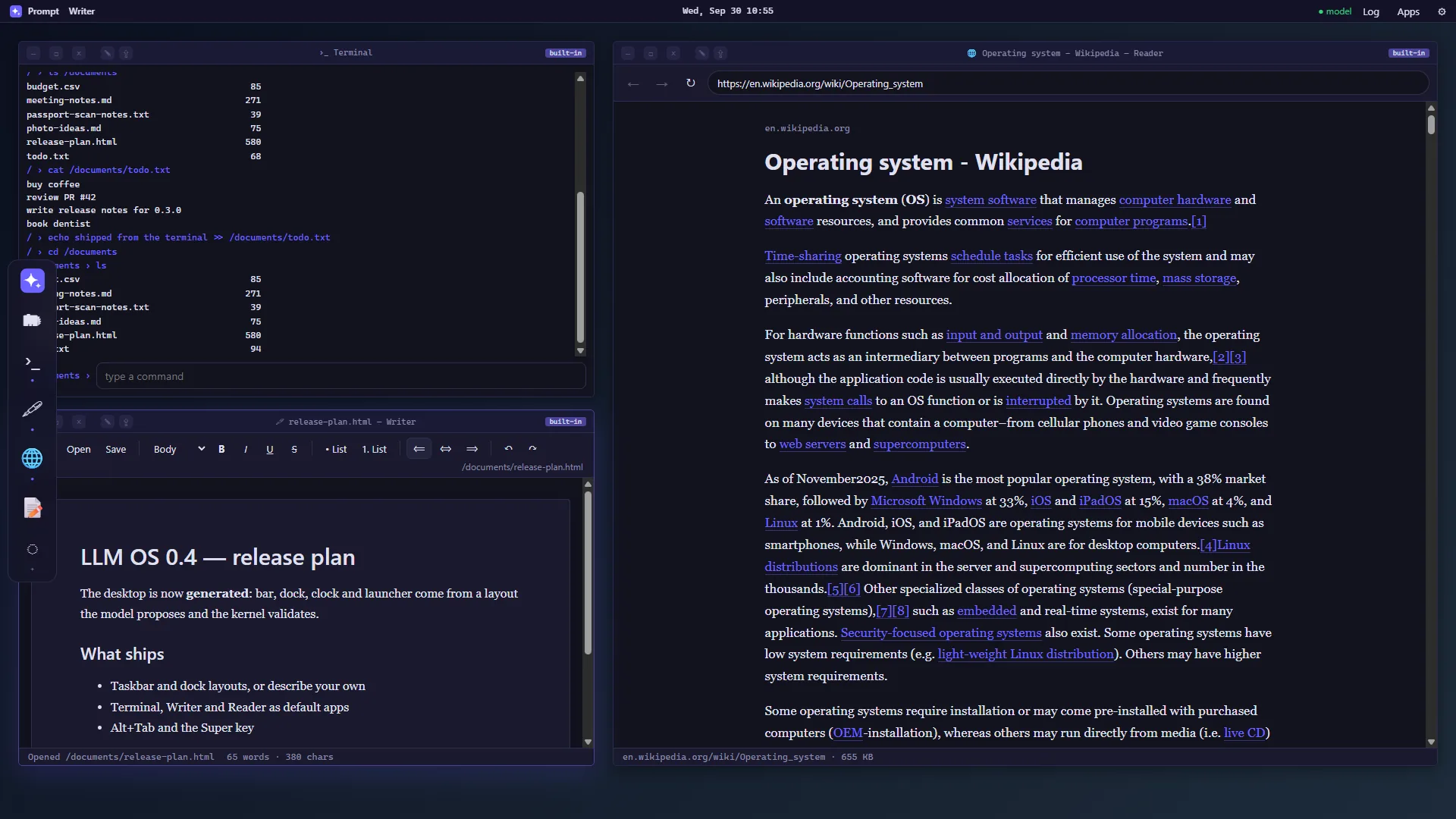
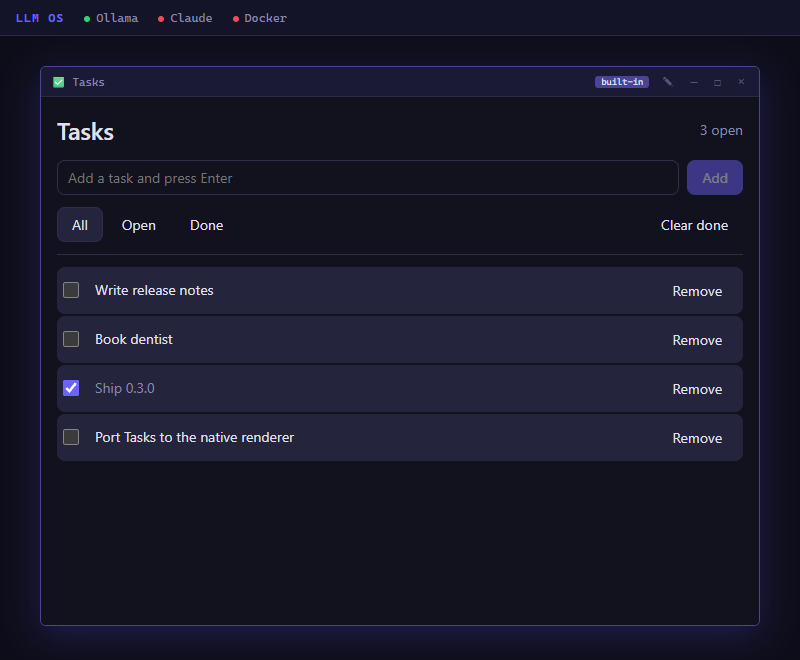
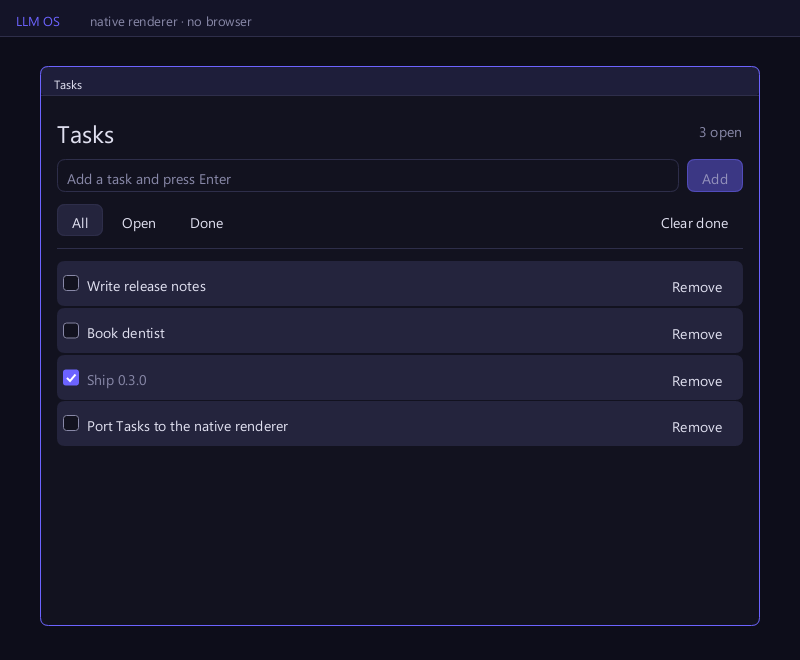
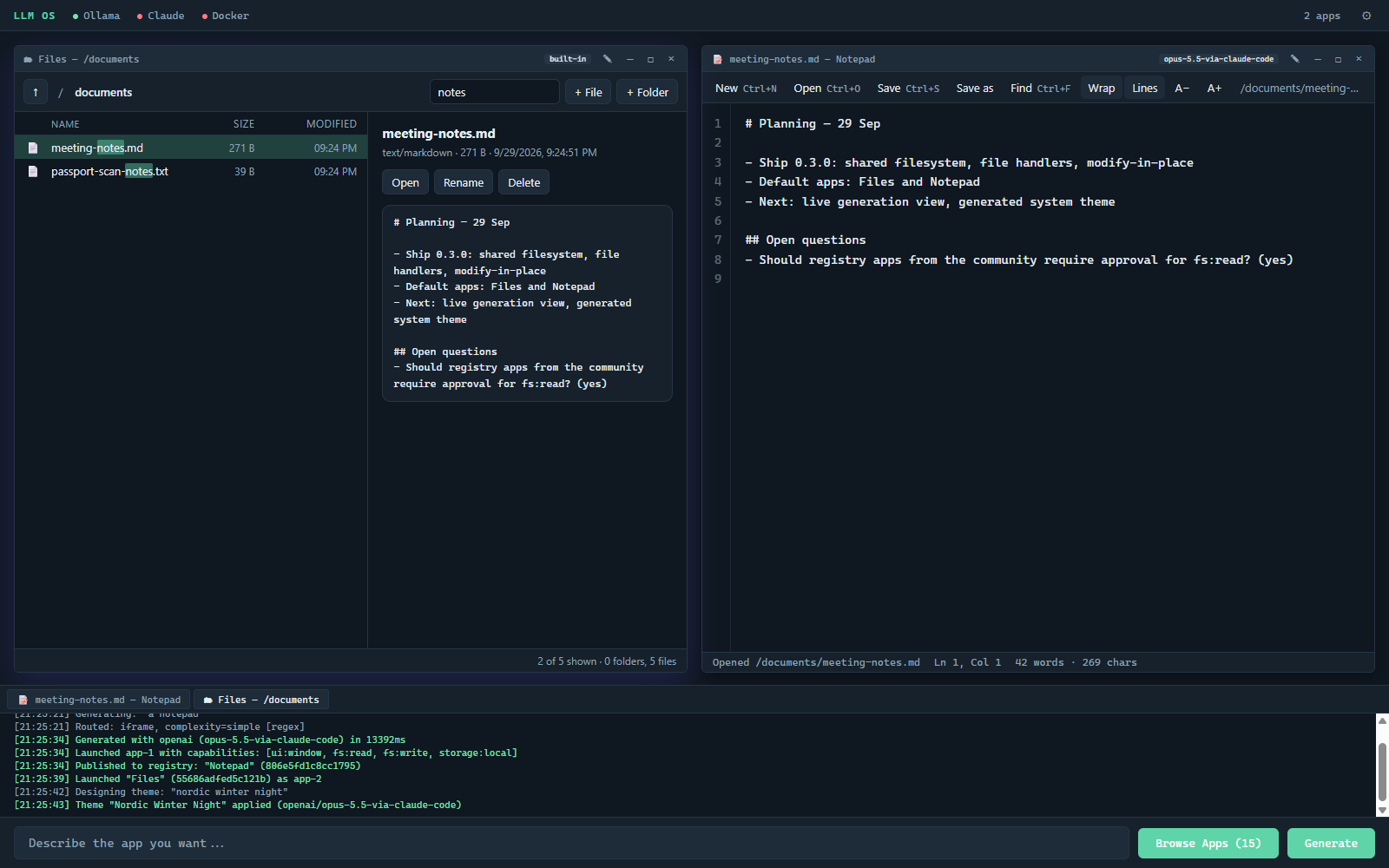
/theme nordic winter night — the shell and both running apps change together, without restarting anything.Same prompt, February and September.
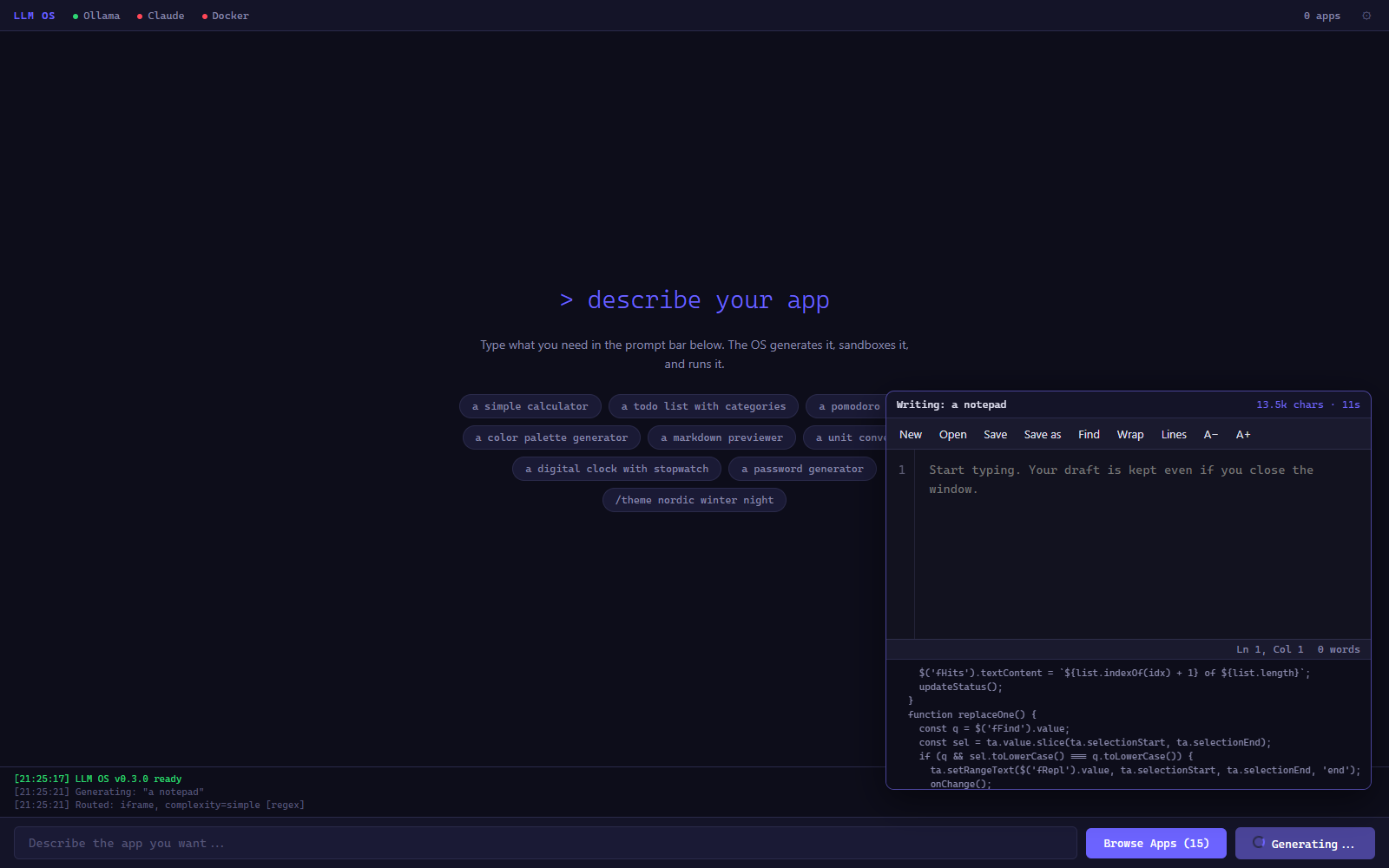
“A notepad”, generated for LLM OS twice. The editor itself was already good in February. What changed is what an app is allowed to be part of.
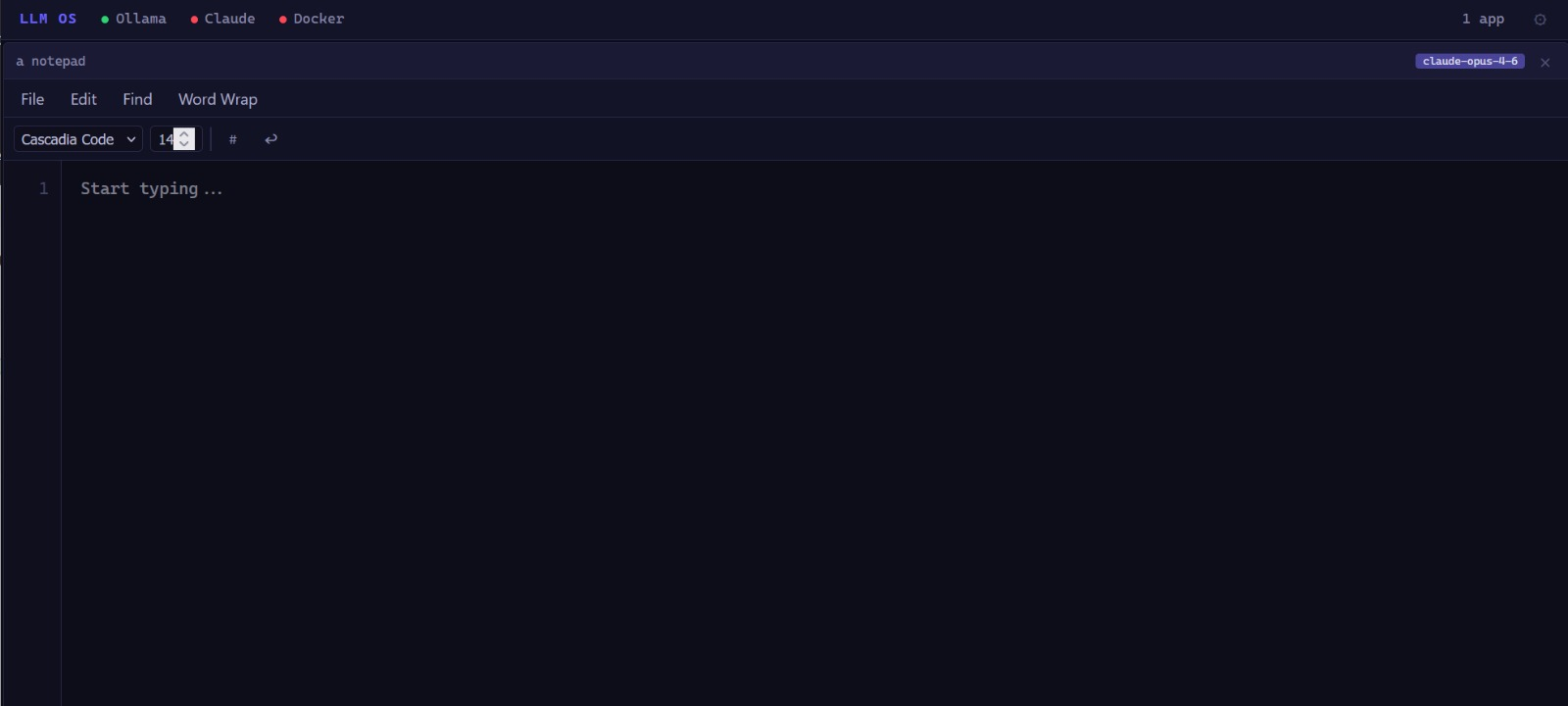
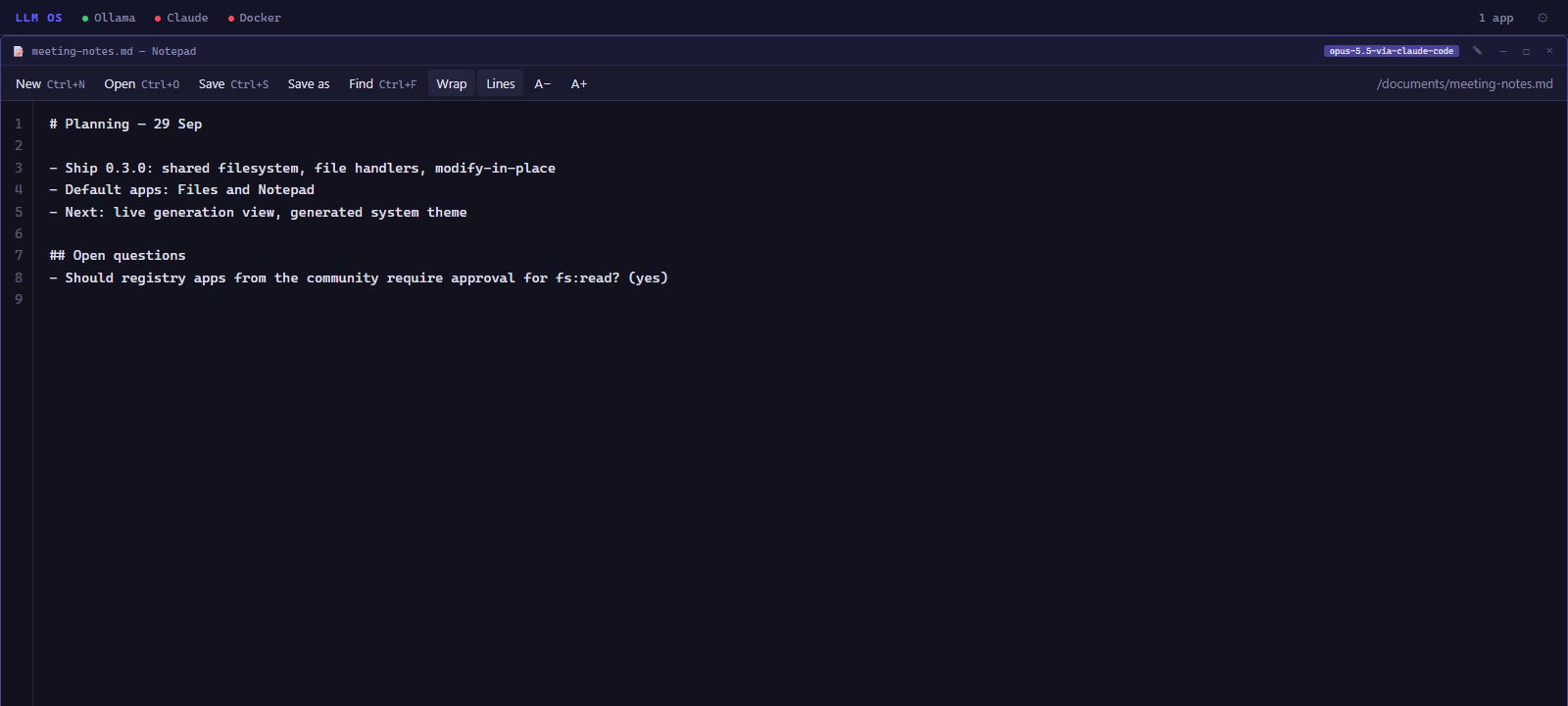
.txt, .md, .csv and friends, keeps an unsaved draft across restarts, and follows the system theme.Seven months and one model generation apart — and the newer model is cheaper to run. That is the point of building an OS this way: a normal program doesn’t get better when models do, but here an app is a prompt with a version history. Press ↻ on any app in the registry and it is written again by whatever model you have today, linked to the version it replaces.
From a sentence to a running program.
The model writes the code. Everything that decides what the code is allowed to do is deterministic.
- You ask“A pomodoro timer that logs sessions to a file.” Add “using opus” to pick a model.
- A router classifies the requestSandboxed page or background process? A tiny local model decides; regex if there is none.
- The gateway picks a model and generatesOllama, Claude, OpenAI or any compatible endpoint. The strongest available model gets the hard requests.
- A static analyzer reads the resultNo LLM in this step.
eval, frame escapes, nested iframes and obfuscation are blocked. - You approve what it may doFiles, network, AI, clipboard — each is a capability you can untick.
- It runs in a sandboxAn iframe with no network and a strict CSP, a WASM worker, or a Docker container for services.
What a generated app can call.
Apps get no direct access to anything. Every service goes through one global object, and each one is tied to a capability the user granted.
| LLMOS.ui | Render elements, notifications, confirm dialogs. | ui:window |
| LLMOS.storage | Private key/value store for the app, kept across restarts and new versions. | storage:local |
| LLMOS.fs | The user’s files, shared by all apps. Read, write, list, stat, mkdir, remove. | fs:read · fs:write |
| LLMOS.os | Launch arguments, open a file in its handler app, set the window title. | — |
| LLMOS.ai | Ask the system’s language model. Lets an app summarise, translate, classify. | ai:generate |
| LLMOS.net | HTTP through the kernel. Public internet only; private and metadata addresses are refused. | network:http |
| LLMOS.ipc | Publish and subscribe between running apps. | ipc:bus |
| LLMOS.clipboard | Read and write the clipboard. | clipboard:rw |
| LLMOS.ui.app | Portable UI: state + a view built from components. Runs in the browser and on the native renderer. | ui:window |
| LLMOS.caps | Check or request a capability at runtime; the user gets a prompt. | — |
Assume the generated code is hostile.
A model can be prompt-injected, and it can simply write bad code. The design doesn’t rely on it behaving.
| Layer | What it stops |
|---|---|
| Prompt sanitizer | Known injection phrasing and hidden zero-width characters before anything reaches a model. |
| Static analyzer | ~35 deterministic rules: eval and friends, frame escapes, service workers, encoded payloads. |
| Iframe sandbox + CSP | No network, no same-origin, no external resources. The app can only post messages to the shell. |
| Shell syscall check | Every message is matched against the capabilities you approved, even if the app bypasses the SDK. |
| Kernel token check | File, network and AI calls also need an HMAC-signed capability token bound to that app. |
| API guard | Other websites and rebound DNS names cannot call the kernel on localhost. |
Found a way out of the sandbox? Please open an issue — it is the most useful thing anyone can contribute.
Local first, cloud when you want it.
Without any model the OS still boots and routes with regex. Add a small local model and it routes better; add a large one and it writes good apps offline.
| Provider | Typical use | Configure |
|---|---|---|
| Ollama | Offline generation with Qwen, DeepSeek Coder and others. Free. | OLLAMA_URL |
| Anthropic | Opus 5 by default; Opus 5.5, Sonnet, Haiku or Fable on request. | ANTHROPIC_API_KEY |
| OpenAI-compatible | OpenAI, OpenRouter, Groq, Together, vLLM, LM Studio. | OPENAI_BASE_URL |
Where this is going.
The long-term idea: the shell, the drivers and eventually the kernel are generated too, and the only thing that persists between boots is your data and your profile. That is years away. This is the near term.
done
- Bootable VM images
- Six-provider model gateway
- Capability tokens
- App registry with versions
- In-place modify and self-heal
- Shared files and file handlers
- Live generation view
- Generated system themes
- Generated desktop layouts
- Portable UI + native renderer spike
next
- Keyboard and mouse for the native renderer
- Run portable apps natively (QuickJS/WASM), no browser in the micro image
- Mail through a kernel IMAP/SMTP service
- Undo: roll an app back to any earlier version
- Evaluation suite for modify/fix quality across models
later
- Multi-file apps with a backend
- The whole shell as portable UI, drawn natively
- Change the screen resolution of the desktop VM — click or describe it, like scaling
- Shell regenerated at boot from your profile
- WASM as the default app runtime
- Rust microkernel, UEFI boot
From source, or as a VM.
No npm dependencies. Node 20 or newer.
git clone https://github.com/DayZAnder/llm-os
cd llm-os
cp .env.example .env      # set OLLAMA_URL and/or ANTHROPIC_API_KEY
node src/server.js        # http://localhost:3000
npm test                  # 604 tests
| Image | Contents | Size | Download |
|---|---|---|---|
| Micro | Buildroot, Node.js, Dropbear. Sandboxed apps only. | ~50 MB | qcow2 · vhdx · ova |
| Server | Alpine, Docker, Node.js. Adds background process apps. | ~700 MB | qcow2 · vhdx · ova |
| Desktop | Server plus a full-screen Chromium kiosk. | ~1 GB | qcow2 · vhdx · ova |
The VM images are from the v0.4.4 release. Attach llmos-data (vhdx, vmdk) as a second disk so your apps and files survive upgrades. Log in as root / llmos and change the password, then open http://<vm-ip>:3000. If you reach the VM by IP instead of a localhost port forward, add that address to LLMOS_ALLOWED_HOSTS. qcow2 for Proxmox/KVM, vhdx for Hyper-V, ova for VirtualBox/VMware. All releases · third-party licenses.
The four rules every change is checked against.
A deterministic scan in CI, a model review on pull requests, and a human with the final say.
- Protect the user first.No telemetry, no tracking. Apps are sandboxed; when in doubt, deny.
- Empower the user.No artificial limits or paywalls. Build whatever you need, as long as it doesn’t harm others.
- Take a piece, leave a piece.Use it freely. If it helps you, give something back.
- Nothing is perfect.Not these rules, not this code. Ship, learn, improve.